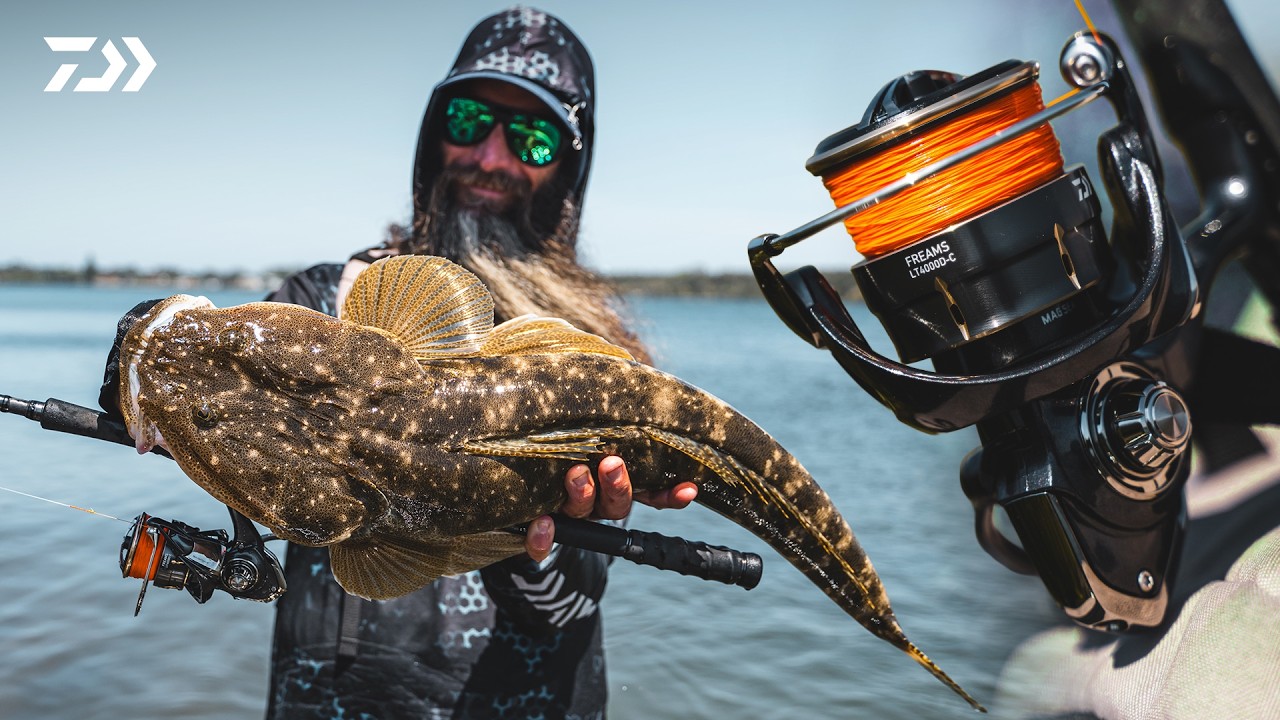
Big dusky flathead reward land-based anglers willing to put in the legwork, but cold water makes them stubborn. On the New South Wales mid-north coast, Daiwa Australia's John Medaka teamed up with local expert Chris Hickson to chase "the big girls" across a maze of sand flats — and learned just how grinding a winter flathead session can be.
The location ticked every box: flats where the water wrapped around an island, fished on a turning tide. Hickson's strategy hinged on reading the sand. "Once you find the area, you're seeing those lies, you're pretty confident — you've just got to pepper it until you actually land on one of the fish," Medaka explained, referring to the body impressions flathead leave when they bury to ambush bait.
The weather had other plans. A stiff northerly and cold water left the fish flat. "The A1 spot was just devoid of life," Hickson said. "The fish didn't seem like they were up in the shallows at all, so we had to resort to going a little bit deeper."
Medaka's opening bite told the story. "It was pretty tentative. The water's really cold, I don't think these fish are super active," he said of a flathead that lay on the lure without committing. His answer is a tactic worth borrowing: fish two rods rigged differently, one with a garfish bait, one with a lure, so a missed bite can be answered with a quick change. "Quite often you'll catch that fish on a different lure a couple of casts later," he said.
It eventually came together. Going "back to the old faithful minnow" and committing to repeated casts over the spot, Medaka hooked up. "I saw its head come out of the water, and I was like, I think it's a big one, Chris," he said. The flathead pushed close to 80 centimetres and spat up a whole whiting — evidence, Hickson noted, that a lure landed right on a flathead's head will get eaten even when the fish aren't actively hunting. The fish was released.
The session distilled a few cold-water truths: when flathead leave the shallow edges, chase them deeper; read the sand and work an area methodically rather than blindly covering water; and accept that the going can be slow. "It was a tough one, mate, the game plan we had sort of didn't pan out," Hickson admitted. Even so, a near-80cm flathead in cold, windy conditions is a result most would gladly take.