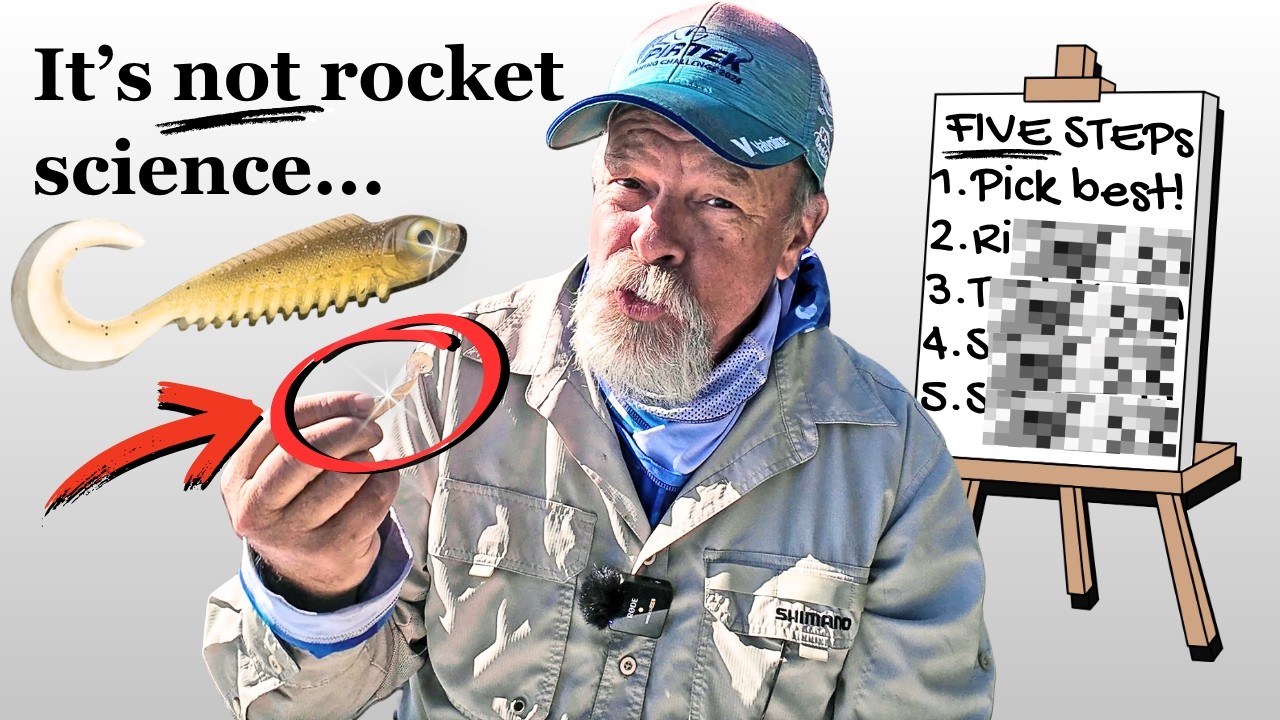
Steve 'Starlo' Starling's newest tutorial - on roughly 11,000 views since it dropped five days ago - reads as a self-audit. Five questions, one bonus pitch and ten minutes of clean-cut Australian estuary footage to back it.
The pitch is bold but disciplined. "What about if I was to tell you that you could take five easy steps that would double your success rate when you're using soft plastics," Starlo opens. He spends the rest of the video showing the steps rather than asking the viewer to take them on faith.
Step one is gear. Starlo's central observation is that the price barrier on quality finesse setups has fallen so far that no recreational angler should still be on inadequate kit. Two hundred dollars buys a sensitive graphite or composite rod, a smooth modern spin reel and a spool of braid. The technology, by his read, has caught up to the application.
"Today's spin reels are much more sophisticated than their predecessors," he said, "and modern graphite or composite rods offer a level of feel that we could only have dreamt of when I was learning to fish."
Line doctrine is unequivocal. Braided polyethylene transformed his finesse fishing and the gap to monofilament is wide enough that he openly recommends a second attempt to anyone who tried braid once and walked away.
"It's no secret that I believe braided polyethylene line has completely transformed our finesse fishing, especially with lures such as soft plastics," he said.
Step two is the rig. The plastic is measured against the jig head, the exit point marked, the body threaded with care and the tail straightened until everything sits flush. The fix is a few seconds. The improvement, Starlo argues, is the difference between a tail that swims and a tail that flatlines.
Step three is the test swim. Every plastic gets dropped at the angler's feet, watched on a slow retrieve, on hops, on the drop and on the bottom. For anglers stuck with dirty water Starlo recommends a swimming pool and a packet of plastics for two hours, on the basis that no theory replaces watching what the plastic actually does in the column.
"Take a heap of plastics and jig heads to a swimming pool somewhere and spend an hour or two doing this stuff," he said. "I absolutely guarantee it'll give you a much clearer understanding of how your lures look in the water and how best to work them."
Step four is the most violated. Slow down. Plastics, in Starlo's repeated experience, do their convincing work at speeds slower than most anglers think possible, with stops, exaggerated pauses and rod-tip movement rather than reel-handle movement providing the action.
"As I like to say, it's not rocket science," he said. "Soft plastics do their best and most convincing work in the vast majority of scenarios when you fish them slow, often much slower than people realise."
The corollary of slow retrieves is line watching. Many takes register as a single tick in the slack belly between rod tip and water surface, hard to read in current or wind, but the difference between a hookup and a stripped tail.
Step five is the hook set. Starlo's frequent complaint is the tentative lift, the rod tip raised an inch as the angler asks himself if it was a real bite. By the time the question is answered, the fish is gone.
"Set the hook," he said. "You don't have to go over the top and break their neck and cross their eyes, but set that hook."
The sixth step, the bonus, is the paid one - Starlo's online soft plastics course, hosted at his own site. The framing is honest. For anglers who want a deeper, species-by-species build-out of the same principles, the course is the next step. For anglers who want a free starter checklist, the five points above are the deal.
The summary is short enough to print on the inside of a tackle box lid. Right gear. Straight rig. Test swim. Slow down. Set the hook. Bream, flathead and snapper, on Starlo's count, will do the rest.