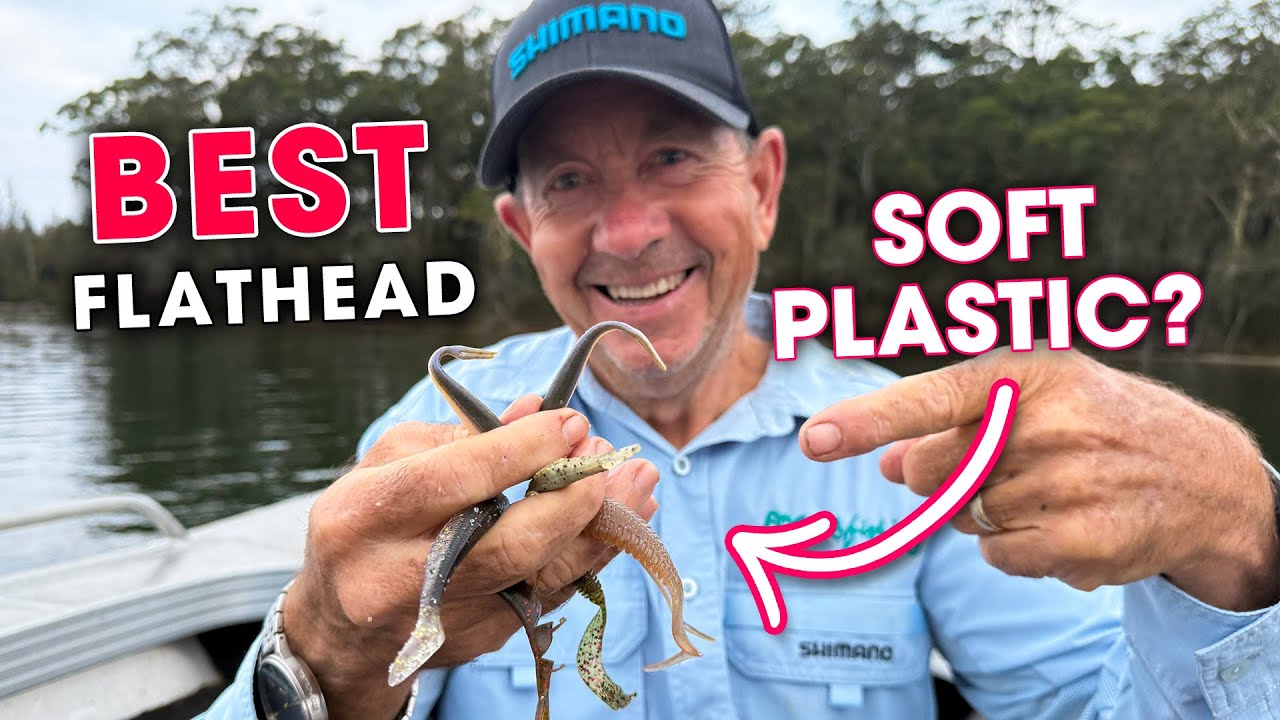
Australian flathead identity Roger Osborne has cut three decades of soft-plastic experiments down to three lures — and runs the lot on six-pound leader, eight-pound braid and a 2-3 kg rod paired with a 1,000-size reel.
"My three best flathead soft plastics from three decades of soft plastic fishing," Osborne said in the opening lines of a new long-form session on his home lake. "I'm not actually brand sensitive. I'm just talking about whatever ones I'm using and the particular styles."
The first plastic on the shortlist is a small minnow profile in silvery-grey-over-white, rigged on a 1/8 oz, 1/0 jig head. "It looks exactly like a little mullet — grey or silvery grey on top and white underneath," Osborne said. "That really does replicate a small mullet, and we know that so many big fish feed on little things like that." The retrieve, he stressed, is line-watch first. "When you wind up the slack line, that means the lure has no choice but to swim towards you as it's going down. That's important."
The second pattern is the wriggle-tail grub, run in the deadly bloodworm colour for the camera and a watermelon-red curl-tail later in the session. "This bloodworm wriggle tail is a really awesome lure and it accounts for so many fish," Osborne said. "It's a real classic." The wriggler picked off a string of just-undersized flathead and a legal flounder bycatch — "my wife absolutely loves flounder," he noted as he dropped the fish in the net.
The third lure is the prawn imitation, and it earned a fish on the first cast. "Would you believe — first cast with the prawn?" Osborne said as a 30-something flathead clipped the small bronze pattern. The rigging tip is to bring the hook out the back of the imitation rather than the underside: "You'll put that in the end of the prawn, try keep it in the centre and squeeze it so the hook comes out the back just far enough along so that when you slide it up onto the plastic it's kind of sitting naturally."
Light gear is the constant theme. "I love fishing with light line because you get so many more bites," Osborne said. "You can land a big fish even on light line." His session also turned up a small snapper that nailed the minnow on the drop, which he flagged as the kind of bycatch the system delivers all the time. "When you get a snapper on one of these little soft plastics, they hit it so hard," he said. "That was so exciting."
Location, Osborne said, sits underneath the lure choice. He worked drop-off edges with the wind off his back, fishing perpendicular to the shore-to-deep transition where flathead ambush passing prey. "I want to be in that transitional spot where it goes from the shallow into the deep," he said. "You know that with flathead they're ambush predators. They lie in wait. They wait for their food to come to them."
For anglers stocking a fresh box, the conclusion is short. "You really only need those three types in your bag if you're wanting to focus on catching flathead," Osborne said. "And you will catch flathead — and you'll catch a variety of other species as well."