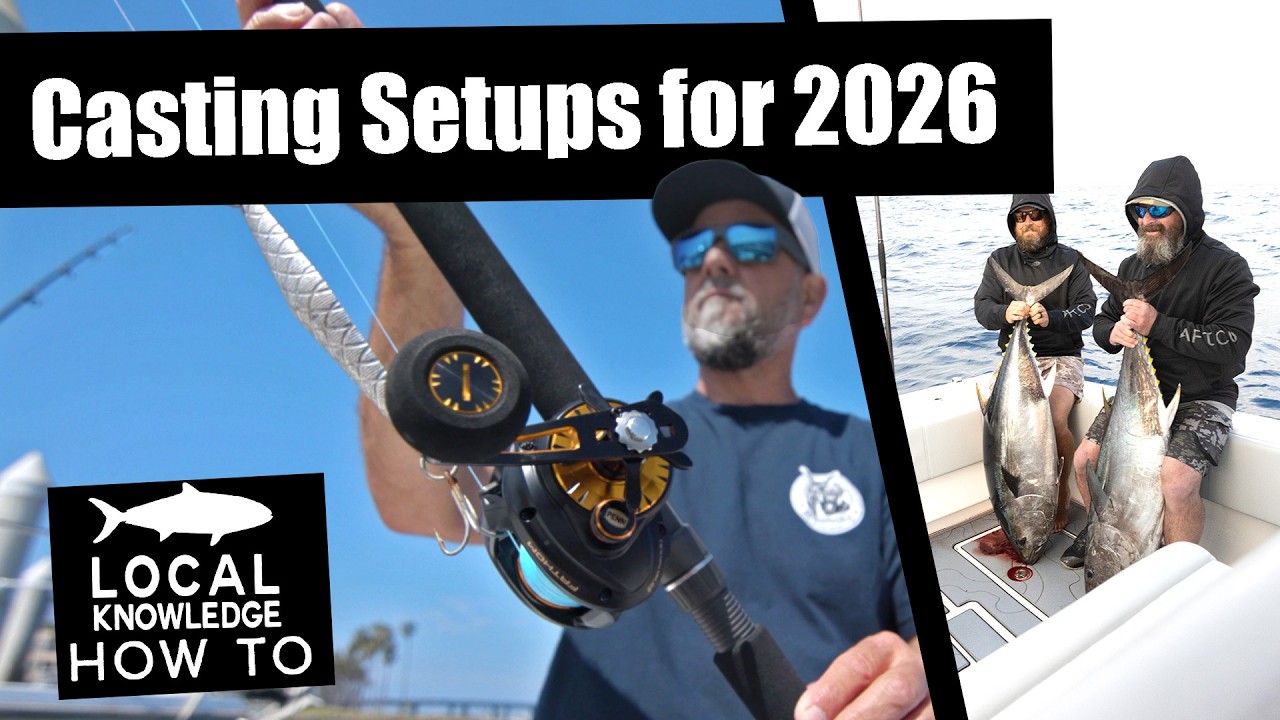
Ali at Local Knowledge has shaken his Southern California bluefin casting rack down to three rods for 2026 — and the new Penn Fathom 500 lever-drag reel is the piece doing most of the talking.
The reel rides his daily-driver setup, a 9-foot Penn jig stick he helped design. Ali has been fishing prototypes of the Fathom 500 for nearly a year and is unsentimental about the punishment they have absorbed.
"We literally did everything in our power to break these and we were unsuccessful," he said. "We've cast it and caught tuna up to about 180 pounds with this reel."
He still keeps the rig honest about its ceiling. "This is going to be my setup that I'll use for tuna up to about 80 or 100 pounds. A 100-pound tuna on a 9-foot jig rod is going to give you all you want and probably more."
The fast-action graphite blank earns its place on charter decks because it shapes casts better than the older, slower 90J rods. "This style of rod allows you to shape a lot more cast so you can throw a low liner into the wind. You can lay it up really high in the wind. You can cast over people," Ali said. "Cast better in tight quarters in my opinion."
The middle rod in the rack is built around a 60-pound braid spool — light by Southern California charter standards, and a deliberate choice. "I know it sounds a little light, but that lets me have 300 yards of line on here in case I hook the wrong fish," he said. "And realistically with 60, you can pull almost as hard as you want and you're not going to break anything."
He runs straight to a 40-pound Seaguar Gold Leader and switches between surface irons, stick baits and poppers depending on what the fish are eating. "Gold has quickly become my favorite Seaguar Leader. It's just easy to tie, very thin, very soft."
The heavy rig was the most painful to develop. About four years ago, Ali says, the bluefin in his patch went off the flyer for two months at a stretch and the only fish coming over the rail were foamers caught on heavy casting gear. The 9-foot jig rods could not handle the bigger class of fish that came up in the foam.
"I went through my Penn rod selection and I found this particular rod. It is an 8-foot rod. I believe it was designed for wahoo bombs. It's rated at 40 to 80 pounds," he said. He pairs it with a black Fathom 25 lever drag two-speed.
The two-speed is a deliberate pick for foamer hunting. "When you cast and don't get bit, or if you cast and miss, you've got really high gearing to get that lure back to the boat as fast as possible," he said. "A lot of times these foamers only stay up for a few seconds. So if you can get a second or third cast in because you've got the speed to retrieve your jig, that can make a huge difference in your day."
The heavy rig also runs 60-pound braid to 80-pound leader, occasionally pushed to 100 or 130 when fish are cutting through. "I'll trade the line capacity for the ability to just pull stupid," he said. "Sixty-pound braid is going to break probably at 70, 75 pounds. That'll let you pull up to 20, 25 pounds of drag, which is a ton on a casting rod and not have to worry about anything."
The lure on the end is whatever heavy yo-yo iron Ali can get to range. "All I'm looking for is a small profile and as heavy as I can get it," he said. "This rod will allow me to throw this about 75 yards give or take, which is still plenty far enough to stay off the school and get a bite."
The discipline behind all three setups, though, comes back to one rule about foamers — and the way clients tend to break it.
"If you can't reach the foam, don't cast. If you're going to off the wrong side of the boat, don't cast," Ali said. "Be patient. That's really been the key."