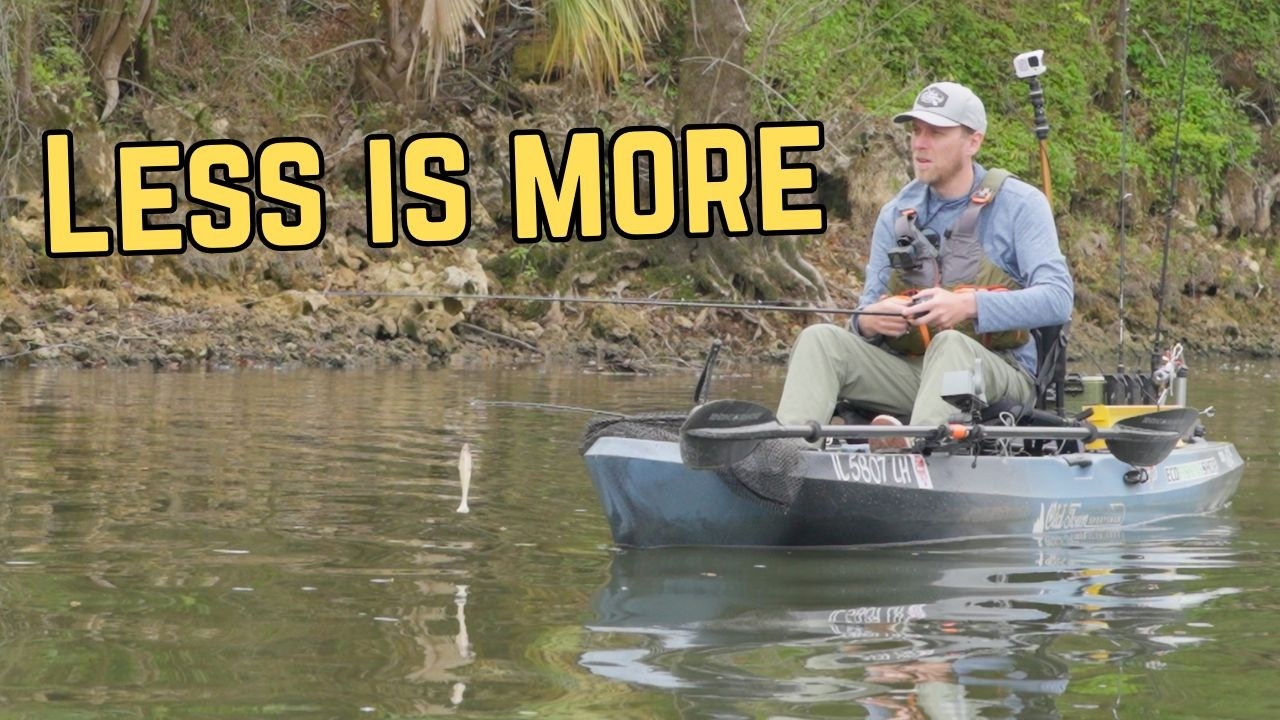
Plenty of kayak content pushes anglers toward ever-bigger, motor-and-graph-laden platforms. The creator behind the IL Yakkin channel is pushing back — and says stripping his setup back to a sub-$1,000 build made him a better fisherman.
"We overcomplicate kayak fishing," he says. His verdict after six months on a budget rig is blunt: "It's probably not the gear, and it's probably not the kayak, holding you back. It's your mentality."
The boat in question is an Old Town Sportsman 120 Paddle, picked up for $799 on a Black Friday sale. He fitted a stern-mounted motor with foot steering — a conversion he says he has since helped more than ten subscribers copy, including Creek Fishing Adventures' John Dalton — and added little beyond a small seat riser. "I wanted something that was a blank canvas," he says.
His central warning is against chasing perfection. "The perfect kayak just doesn't exist," he says, noting that a creek boat and a big-water live-scoping platform are "two different tools for two different things." Years of upgrades, he admits, never solved the real problem: "Upgrading my kayak multiple times over five or six years wasn't helping me catch more fish."
So what did the cheap rig deliver? Stability that let him stand and fish far more through winter — a boon for his favourite jerkbait. "The best way to fish a jerkbait from a kayak is in the standing position," he says. Faster launches and limited rod storage also forced discipline. "Because I'm limited on how many rods I feel comfortable bringing, I plan my trips out a lot better," he says. "It forced me to think smarter about what to bring."
He is no purist — he praises NuCanoe's modular designs and accepts big-water anglers benefit from larger platforms. The key, he says, is fit: "Buy a kayak that fits your needs. Buy a kayak that's going to help your goals." His bottom line lands hard against gear-obsessed culture: "The kayak is the last thing you should be worrying about when you're fishing. The kayak is a tool. You should be focusing on catching the most fish." By simplifying, he says, he finally did.